Key takeaways
- Compare five sunrise alarm clocks with gradual wake-up light, natural sounds, FM radio and dimmable displays, plus tips on brightness and sunrise length.
- Top Pick: Philips SmartSleep Wake-Up Light HF3520/60
- Runner-up: Philips SmartSleep Sleep and Wake-Up Light HF3650/60
- Also consider: Philips SmartSleep Wake-Up Light HF3500/60
A sunrise alarm clock swaps the sudden blast of a standard buzzer for a lamp that brightens gradually in the run-up to your set wake time. The light starts low and warm, climbs through a programmed ramp, and reaches full brightness around the time the alarm sound begins. Most models pair that light show with a clock display, a choice of wake sounds, and extras such as FM radio, a sunset wind-down mode, or a bedside reading light.
The five clocks below cover the main approaches to the category. Philips builds button-controlled wake-up lights with no app and no account, in simple and full-featured versions. Hatch takes the opposite route with an app-set smart clock built around routines and a large sound library. JALL sits at the practical end with dual alarms, colored light modes, and a compact footprint. Comparing brightness, ramp length, sound options, and display behavior makes the right pick much easier.
As an Amazon Associate, we earn from qualifying purchases.
Quick Answer
For most bedrooms, the Philips SmartSleep Wake-Up Light HF3520/60 is the most complete pick: colored sunrise and sunset simulation, 20 brightness settings, five natural sounds and FM radio, with no app required. The Philips HF3650/60 adds brightness and more sounds, the Hatch Restore 3 suits app fans, the Philips HF3500/60 keeps things simple, and the JALL K8 covers dual alarms on a small footprint.
1. Philips SmartSleep Wake-Up Light HF3520/60

The HF3520/60 is the long-running benchmark of the category and the model most other wake-up lights are measured against. Its sunrise moves through red, orange, and yellow tones as it brightens, and a matching sunset simulation reverses the process in the evening, dimming gradually over a set period. Twenty brightness settings give the lamp a second job as a bedside reading light, and the time display dims automatically so it does not glare across a dark room.
Sound is covered by five natural wake-up sounds plus an FM radio tuner, and the tap snooze function lets you silence the alarm with a tap on the top of the unit. Everything is set on the clock itself, so there is no app to install and no account to create. The housing is larger than a typical alarm clock, so measure your nightstand before ordering.
Specs
- Model: HF3520/60
- Simulation: colored sunrise and sunset
- Brightness: 20 settings, up to 300 lux
- Wake sounds: 5 natural sounds
- Radio: FM radio
- Extras: reading lamp, tap snooze, auto-dimming display
- Power: 16.5 watts
- Dimensions: 6 x 10 x 10 inches
- Warranty: 2 years
2. Philips SmartSleep Sleep and Wake-Up Light HF3650/60
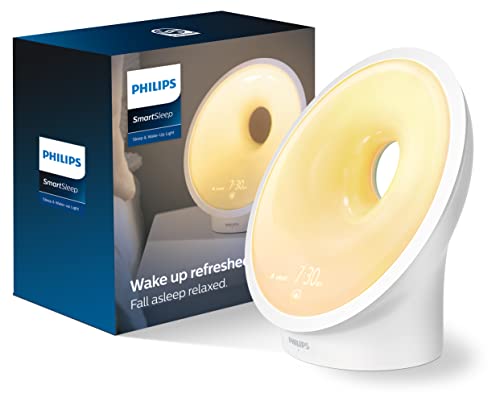
The HF3650/60 is the step-up Philips model, adding brightness headroom and a wider sound selection over the HF3520/60. It offers 25 brightness settings with a peak output of 310 lux as listed, seven wake-up sounds, and an FM radio. The sunrise and sunset simulations carry over, and this model adds the RelaxBreathe feature listed by Philips, a light-guided wind-down routine for the evening.
A tap on the top of the unit switches on a low night light, handy for checking the time or finding a glass of water without turning on a main light. Like its sibling, the HF3650/60 is controlled entirely on the device, so setup stays phone-free. If you want the strongest light output Philips offers in a clock with physical controls, this is the one to look at.
Specs
- Model: HF3650/60
- Simulation: sunrise and sunset
- Brightness: 25 settings, up to 310 lux as listed
- Wake sounds: 7 sounds
- Radio: FM radio
- Extras: RelaxBreathe wind-down feature, tap-top night light
- Power: 18 watts
- Warranty: 24 months
- App required: no
3. Hatch Restore 3
The Hatch Restore 3 takes a different approach from the Philips clocks. It is a smart light, sound machine, and sunrise alarm in one fabric-covered unit, set up and programmed through the Hatch Sleep app over a 2.4 GHz Wi-Fi connection. You build routines that pair light sequences with audio: a wind-down routine in the evening and a sunrise that brightens ahead of your chosen alarm sound in the morning.
The built-in library carries more than 80 sleep sounds, and an optional Hatch+ subscription adds further content; the core sunrise alarm and routines work without it. The digital clock display is dimmable for dark rooms, and daily operation uses buttons on the device itself once routines are set. Choose the Restore 3 if you like app control and a deep sound library, and skip it if you want a clock that never touches your phone.
Specs
- Model: RESTORE05 (Restore 3)
- Type: sunrise alarm clock, sound machine, smart light
- Display: digital, dimmable
- Control: Hatch Sleep app for setup and routines; on-device buttons for daily use
- Sound: built-in library of 80+ sleep sounds
- Connectivity: 2.4 GHz Wi-Fi
- Dimensions: 5.69 x 1.5 x 7.23 inches
- Optional subscription: Hatch+ for additional content
4. Philips SmartSleep Wake-Up Light HF3500/60
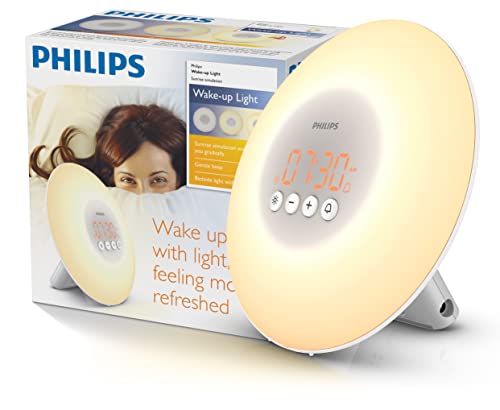
The HF3500/60 is the simplest clock in this guide and the one to pick if you want the sunrise effect without menus full of options. It runs a fixed yellow sunrise simulation across 10 brightness levels, reaching up to 200 lux as listed, and pairs it with a single wake-up beep rather than a sound library. There is no sunset simulation and no radio on this model.
That simplicity is the point. Setup is quick, the controls are minimal, and the smaller wattage keeps it firmly in bedside-lamp territory. If you read the HF3520/60 spec list and found yourself ignoring the radio, the extra sounds, and the sunset mode, the HF3500/60 covers the core feature, the gradual brightening, on its own. Confirm the exact alarm behavior on the listing if you need a specific snooze arrangement.
Specs
- Model: HF3500/60
- Simulation: sunrise only
- Brightness: 10 levels, up to 200 lux as listed
- Wake sounds: 1 beep
- Sunset simulation: not listed, confirm on the listing
- Radio: not listed, confirm on the listing
- Power: 7.5 watts
- Warranty: 2 years
5. JALL Wake Up Light Sunrise Alarm Clock (K8)

The JALL K8 is the practical, family-friendly entry here. It combines a sunrise simulation with dual alarms, so two different wake times can be set on one clock, and adds an FM radio, a snooze function, and a nightlight. The light offers seven colors, which makes it a popular pick for kids’ rooms as well as adult bedrooms, and the round 7.2-inch face keeps the footprint modest.
Seven natural sounds cover the alarm tones, and the sunset side of the feature list includes a sleep aid mode as listed by the maker. The K8 does not publish a lux figure in the listing information we reviewed, so if peak brightness is your deciding factor, treat that detail as unconfirmed and check the listing before buying.
Specs
- Model: K8
- Simulation: sunrise simulation; sunset sleep aid mode as listed
- Light: 7 colors, nightlight function
- Wake sounds: 7 natural sounds
- Alarms: dual alarms
- Radio: FM radio
- Snooze: yes
- Dimensions: 7.2 x 7.2 inches
- Peak brightness: not published in the listing, confirm on the listing
How to Choose a Sunrise Alarm Clock
Start with brightness. Makers who publish a lux figure measure it at a set distance, so compare the numbers as a rough guide rather than an exact science, and note that some brands publish no figure at all. A higher peak output matters most in rooms that get early daylight through curtains, where a dim lamp has to compete.
Next, check the sunrise length. Some clocks fix the ramp, while others let you stretch or shorten it, anywhere from around 10 minutes to over an hour on the most adjustable models. A longer, slower ramp suits people who want the light to do most of the waking; a shorter ramp suits anyone who still relies on the alarm sound.
Then look at sound and controls. Decide whether you want natural sounds, FM radio, or a plain beep, and whether you prefer setting everything on the clock or through an app. Finally, check the display: a display that dims or switches off fully keeps the room dark, and dual alarms are worth having if two schedules share one nightstand. Battery backup behavior during a power cut varies by model, so confirm that detail on the listing if it matters to you.
Who Should Skip a Sunrise Alarm Clock
Skip this category if you share a bed with a partner on a very different schedule, since a lamp brightening for half an hour will light the room for both of you. Skip it if you sleep in a fully blacked-out room by choice and prefer total darkness until a loud alarm fires; a basic clock radio does that job for less.
You should also skip the app-based models if you are trying to keep phones out of the bedroom entirely, and skip sunrise clocks altogether if your wake time changes daily, since the benefit of a programmed ramp depends on setting it the night before. Shift workers with rotating patterns often do better with a loud, simple alarm they can reset in seconds.
Frequently Asked Questions
How does a sunrise alarm clock work?
You set a wake time, and the clock begins brightening its lamp before that time, following a programmed ramp from dim to full brightness. When the ramp ends, the alarm sound starts at the set time. The exact ramp length and whether it is adjustable depend on the model.
Can I use the wake-up light without any sound?
On most models, yes. The sunrise simulation and the alarm sound are usually separate settings, so the light can run on its own or the sound can play with no light ramp. Check the listing for the specific model, because the simplest clocks pair a fixed beep with the light.
What is the difference between sunrise and sunset simulation?
Sunrise simulation brightens the lamp gradually before a morning alarm. Sunset simulation does the reverse in the evening, dimming the light gradually over a set period before it switches off. Not every clock has both; the Philips HF3500/60, for example, lists sunrise only.
How bright should a sunrise alarm clock be?
Published peak figures for the clocks in this guide run from 200 to 310 lux. Treat the number as one factor alongside ramp length and lamp placement: a clock on a nightstand close to the bed delivers more of its output to you than the same clock across the room.
Final Verdict
The Philips SmartSleep HF3520/60 remains the easiest recommendation: full colored sunrise and sunset simulation, useful brightness, natural sounds, FM radio, and no app. Step up to the HF3650/60 for more brightness and sounds, choose the Hatch Restore 3 if app-built routines and a large sound library appeal, take the HF3500/60 for the simplest possible version, and consider the JALL K8 when dual alarms and a compact, colorful clock fit the room.