Key takeaways
- Five pressure washers compared on PSI, GPM, hose length and nozzles, from compact electric models for cars and decks to a gas machine for big driveways.
- Top Pick: Westinghouse ePX3500 Electric Pressure Washer
- Runner-up: Sun Joe SPX3000 Electric Pressure Washer
- Also consider: Karcher K5 Power Control Electric Pressure Washer
A pressure washer turns slow scrubbing jobs into short ones: green algae on a patio, mud caked onto a driveway, pollen film on siding, and road grime on a car all rinse away with the right combination of pressure and water flow. The catch is that the biggest number on the box is not always the one that matters. Pressure (PSI) loosens dirt, but flow (GPM) is what carries it away, and the nozzle fitted to the wand changes both.
This guide compares five machines for home use: four corded electric models, plus one gas model for large areas and off-grid work. Every figure is stated the way the listing states it, including max versus rated output where the maker gives both. Follow the maker’s safety directions, start on the gentlest nozzle, and never point the jet at people, pets, or electrical fittings.
As an Amazon Associate, we earn from qualifying purchases.
Quick answer
For most homes, an electric pressure washer rated between 2,000 and 2,500 max PSI with at least 1.2 GPM covers cars, decks, siding, and patios. The Westinghouse ePX3500 is the easiest electric pick here, while the gas Westinghouse WPX3400 suits large driveways and off-grid work. Match the nozzle to the surface and follow each maker’s safety directions.
Westinghouse ePX3500 Electric Pressure Washer

The ePX3500 is built around stability. Its anti-tipping design uses four quick-lock wheels that steer in every direction, so the machine follows you around the car or along the fence line instead of toppling when the hose tugs. The listing rates it at 2,500 max PSI and 2,000 rated PSI, with 1.76 max GPM and 1.2 rated GPM, which is honest, usable output for driveways, siding, and patio furniture.
An onboard soap tank and a pro-style steel wand come in the box, along with a five-nozzle set covering pinpoint, fan, turbo, and soap patterns. The 25-foot hose stores on an onboard spool. For most households, this is the most rounded electric package in the guide.
Specs
- Max pressure: 2,500 PSI (2,000 PSI rated, as listed)
- Flow rate: 1.76 max GPM (1.2 GPM rated, as listed)
- Power source: corded electric
- Hose length: 25 feet
- Nozzles: 5-nozzle set (0, 15, 25, turbo, and soap, as listed)
- Detergent: onboard soap tank
- Wand: pro-style steel wand
- Design: anti-tipping body with four steering wheels
- Weight: confirm on the listing
- Warranty: 3-year limited coverage, as listed
Sun Joe SPX3000 Electric Pressure Washer

The SPX3000 is the long-running family favorite in this class, and its listing separates the headline figure from the tested one: 2,500 max PSI, with 2,030 PSI as the PWMA-rated working pressure, and 1.2 GPM of flow from a 14.5-amp, 1,800-watt motor. That output handles the standard home list of cars, decks, fences, and concrete without drama.
Its distinguishing feature is the dual detergent system: two removable 0.9-liter tanks let you keep car shampoo in one and a house or deck cleaner in the other, switching without rinsing a tank mid-job. If you wash vehicles often and switch detergents regularly, this layout saves real time.
Specs
- Max pressure: 2,500 PSI (2,030 PSI PWMA rated, as listed)
- Flow rate: 1.2 GPM, as stated in the listing
- Motor: 14.5-amp, 1,800-watt
- Detergent: dual onboard tanks, 0.9 liters each
- Hose length: 20 feet
- Power cord: GFCI cord, 35 feet as listed
- Nozzles: 5 quick-connect nozzles (0, 15, 25, 40, and soap, as listed)
- Weight: confirm on the listing
Karcher K5 Power Control Electric Pressure Washer
The K5 Power Control is the premium electric step-up. Karcher lists a working pressure of 2,000 PSI with a 2,500 PSI maximum, and a flow rate of 1.55 GPM, the highest flow among the electric picks here, which means faster rinsing on wide surfaces like driveways and house walls. Its water-cooled induction motor is built for longer service life than a basic universal motor.
Pressure is adjusted on the Power Control gun itself, and the two included wands split the work: the Vario Power wand for general and delicate surfaces, and the DirtBlaster wand for stubborn grime on hard paving. A 32-foot hose gives the longest reach in this guide. Choose this one if you wash often and want the machine to last.
Specs
- Working pressure: 2,000 PSI (2,500 PSI max, as listed)
- Flow rate: 1.55 GPM
- Motor: water-cooled induction motor
- Hose length: 32 feet
- Wands: Vario Power and DirtBlaster spray wands with Power Control gun
- Detergent: onboard detergent tank
- Weight: confirm on the listing
CRAFTSMAN Electric Pressure Washer, Cold Water, 2100-PSI, 1.2 GPM, Corded (CMEPW2100)
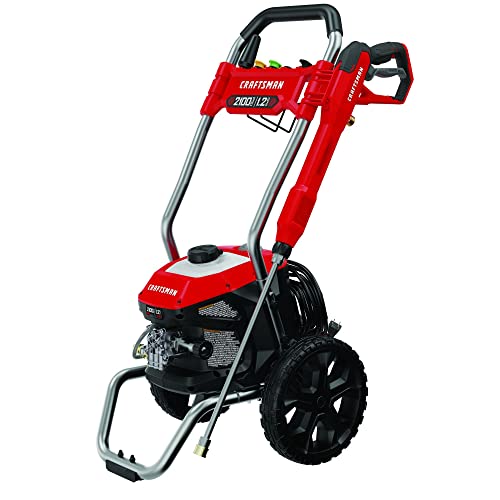
The CMEPW2100 keeps the formula simple: 2,100 max PSI and 1.2 GPM of cold water from a corded electric motor, with CETA certification stated on the listing. That output is well matched to cars, small decks, siding, and walkways, and the machine adds reach where some rivals cut corners: a 25-foot kink-resistant hose and a 35-foot power cord.
An integrated soap tank handles detergent without a separate bottle, and a turbo nozzle is included for concentrated cleaning on hard surfaces. Ten-inch wheels make it easy to move over grass and gravel. It is a sensible pick for smaller properties where storage space and cord reach matter more than raw output.
Specs
- Max pressure: 2,100 PSI
- Flow rate: 1.2 GPM
- Power source: corded electric, cold water
- Hose length: 25 feet, kink-resistant
- Power cord: 35 feet
- Detergent: integrated soap tank
- Nozzles: turbo nozzle included; full nozzle set, confirm on the listing
- Wheels: 10-inch
- Certification: CETA certified, as listed
- Weight: confirm on the listing
Westinghouse WPX3400 Gas Pressure Washer

The WPX3400 is the gas option, and it plays a different game: 3,400 PSI and 2.6 max GPM from a 212cc four-stroke OHV engine with recoil start. That flow rate is roughly double the electric picks, which is what shortens big jobs like long driveways, large decks, and farm or workshop yards. There is no cord, so it works anywhere you can carry fuel.
Twelve-inch never-flat wheels and a steel frame suit rough ground. Gas ownership brings extra duties: engine oil, fuel storage, winterizing where required, and noise. Never run it indoors or in an enclosed space, because engine exhaust is dangerous; follow the maker’s directions on ventilation and maintenance.
Specs
- Max pressure: 3,400 PSI
- Flow rate: 2.6 max GPM
- Engine: 212cc four-stroke OHV, recoil start
- Fuel tank: 1 gallon, as listed
- Detergent: onboard soap tank, half gallon as listed
- Hose length: 25 feet, abrasion resistant
- Nozzles: 5 quick-connect nozzles (0, 15, 25, 40, and soap, as listed)
- Wheels: 12-inch never-flat
- Warranty: 3-year limited coverage, as listed
- Weight: confirm on the listing
How to choose
Start with your biggest regular job. Cars, bikes, and patio furniture need only gentle output, around 1,300 to 1,900 PSI with a wide fan nozzle. Siding, decks, and fences sit in the 2,000 to 2,500 max PSI electric class covered by most picks here. Long driveways, large areas of concrete, and paint or oil-stained hard surfaces are where higher flow, or the gas machine, earns its keep.
Read both numbers on any listing. Max PSI is a peak figure; the rated or working PSI and the GPM beside it describe the water you actually get. A machine with moderate PSI and higher GPM often rinses a driveway faster than a high-PSI, low-flow unit, because flow does the carrying. PWMA or CETA ratings, where listed, mean the figures were measured to an industry standard.
Then check the practical details: hose and cord length against the distance from your outlet and tap to the farthest corner you clean; detergent handling, whether a tank, dual tanks, or a siphon setup; nozzle range, since a turbo nozzle helps hard surfaces while a soap nozzle and wide fan protect car paint and wood; and storage. For gas models, add engine maintenance and safe fuel storage to the list.
Who should skip
Skip the gas WPX3400 if you live in a flat or a small house with close neighbors: it is louder than the electrics, needs fuel and oil care, and its output is more than small jobs require. Skip every model here if your cleaning is limited to a car and a balcony; a compact washer or a hose with a good nozzle will do.
Also skip pressure washing entirely on lead paint, asbestos siding, damaged mortar, and unsealed or crumbling surfaces. On any surface you are unsure about, the maker’s directions and a test patch in a hidden spot come first. If you only face one big job a year, renting a machine for the weekend is usually smarter than buying and storing one.
FAQ
How much PSI do I need for a driveway and patio?
For home concrete and paving, the 2,000 to 2,500 max PSI electric class in this guide is the common choice, using a 25 or 40 degree fan nozzle and steady passes. Very large or heavily stained driveways clean faster with higher flow, which is where the gas WPX3400 at 2.6 max GPM has its advantage. Always start with the widest nozzle and the greatest distance, then move closer only as the surface allows.
Is a gas pressure washer better than an electric one?
Neither is better outright; they suit different properties. Gas gives higher flow and total freedom from cords, at the cost of noise, exhaust, fuel handling, and engine maintenance. Electric models are quieter, start with a trigger pull, and need almost no upkeep, but they are limited by cord and hose reach and by household outlet power.
Can a pressure washer damage a car or a wood deck?
Yes, if it is used too close or with too narrow a jet. For cars, use a wide fan nozzle, keep a sensible distance, and avoid blasting badges, trim seals, and chipped paint. For wood, use a fan pattern and even strokes along the grain, and never use the pinpoint 0 degree nozzle, which can cut into timber and skin. The maker’s directions for each surface come before any general advice.
What should I check before using a pressure washer for the first time?
Read the manual first, then check the basics: a GFCI-protected outlet for electric models, a secure garden hose connection with the water on before starting, the correct nozzle clicked fully into the wand, and eye protection. Clear the area of loose items and keep children and pets away. For gas models, fill fuel outdoors, let a hot engine cool before refueling, and never operate indoors.
Final verdict
For most households, the Westinghouse ePX3500 is the pick: honest rated output, a stable four-wheel design, an onboard soap tank, and a full nozzle set. The Sun Joe SPX3000 is the close alternative for anyone who switches detergents often, thanks to its dual tanks, while the Karcher K5 Power Control is the upgrade for frequent use, with the highest electric flow rate here and an induction motor. The CRAFTSMAN CMEPW2100 covers smaller properties neatly with long reach and simple upkeep, and the gas Westinghouse WPX3400 stands alone for big areas and off-grid work. Pick by your largest regular job, verify the current specs on the listing, and follow the maker’s safety directions every time.