Key takeaways
- Compare the best board games for families, from Ticket to Ride and Catan to Azul, Codenames and Splendor, with player counts, ages and play times.
- Top Pick: CATAN Board Game (6th Edition)
- Runner-up: Azul Board Game
- Also consider: Final Verdict
A family game night succeeds or fails on fit. The right game matches the youngest player at the table, the rules teaching the group will tolerate, and the time left before bedtime. A strategy game that needs four players and ninety minutes is the wrong purchase for a household that usually plays in pairs after dinner, and a light party game will bore a family that wants a real contest.
The five games below are established modern titles that cover the situations families actually face: a first step beyond the classics, a trading game for negotiators, a word game for a crowd, a quiet tactical game, and a fast card-driven race. Every pick is a complete base game, so nothing extra is required to play well. Player counts, maker ages, and playing times are taken from the Amazon listings, and anything not stated there is marked so you can confirm it before ordering.
As an Amazon Associate, we earn from qualifying purchases.
Quick Answer
For most families, Ticket to Ride (2025 Refresh) is the safest first buy: ages 8 and up, two to five players, and rules a new player can learn within one round. CATAN adds trading and negotiation for ages 10 and up, Codenames suits bigger groups, Azul is the quiet two-to-four-player option, and Splendor is the fast engine-building pick.
1. Ticket to Ride Board Game (2025 Refresh)
Ticket to Ride is the game most often recommended as a family’s first modern board game, and the 2025 Refresh keeps the proven formula: a map of North America, a hand of colored train cards, and a simple choice on every turn. You either draw more train cards, spend matching cards to claim a route between two cities, or take extra destination tickets. Completed tickets earn points, unfinished ones lose them, and a bonus goes to the longest connected route.
The appeal for mixed-age groups is that turns are quick, the goal is visible on the board, and a younger player can compete by focusing on their own tickets while adults add blocking and route planning. There is mild indirect conflict when a rival claims a route you wanted, but nobody is eliminated. It plays well at three and four players, works at two as a tighter race, and seats five without slowing down much.
Specs
- Publisher: Days of Wonder (Asmodee)
- Players: 2 to 5
- Maker age: 8 and up
- Playing time: 30 to 60 minutes
- Components: game board, 225 plastic trains in five colors, 110 train cards, 33 destination tickets, longest path bonus card, 5 wooden scoring markers, rules booklet
- Model number: DOW7201N
- Map and any regional variants: confirm on the listing
2. CATAN Board Game (6th Edition)

CATAN is the trading game on this list. Players settle an island of terrain hexes that produce wood, brick, sheep, wheat, and ore whenever the dice match their numbers. Resources are spent on roads, settlements, and cities, and because nobody produces everything they need, trading with the other players is the engine of the game. The first player to reach ten victory points wins.
This is the most interactive pick here, and the right choice for families who enjoy negotiation and table talk. It is also the most demanding: the base game needs three or four players, so it does not work as a two-player game out of the box, and younger children can struggle with the resource planning. Dice luck plays a role, which keeps weaker players in contention but can frustrate someone who wants full control. Families of five or six should note that larger player counts require a separate extension, so confirm the box contents on the listing before ordering.
Specs
- Publisher: CATAN Studio (Asmodee)
- Players: 3 to 4
- Maker age: 10 and up
- Playing time: 60 to 90 minutes
- Edition: 6th Edition
- Model number: CN3081
- Components and any included extension: confirm on the listing
3. Codenames Board Game (2nd Edition)
Codenames turns family game night into a team word game. Twenty-five word cards are laid out in a grid, and each team’s spymaster knows which words belong to which side. Spymasters give one-word clues meant to point at several of their team’s words at once, while their teammates discuss and guess. One card is the assassin, and guessing it loses the game on the spot, which keeps every clue tense.
Because it is played in two teams, Codenames handles larger groups better than anything else in this guide: cousins, grandparents, and guests can all join a side, and the discussion does most of the entertaining. The second edition refreshes the word set with 200 cards carrying 400 codenames and 40 key cards, so repeat plays stay varied. Two cautions matter for families. The listing gives a maker age of 14 and up, mainly because younger children may not know enough vocabulary to enjoy clue-giving, and the game needs at least four players to work as designed.
Specs
- Publisher: Czech Games Edition (CGE)
- Players: 4 to 8 and up, in two teams
- Maker age: 14 and up, per the listing
- Playing time: confirm on the listing
- Components: 200 cards with 400 codenames, 40 key cards, 16 agent tiles in two colors, 1 double agent tile, 7 innocent bystander tiles, 1 assassin tile, card stand, rulebook
- Model number: CGE00125
4. Azul Board Game
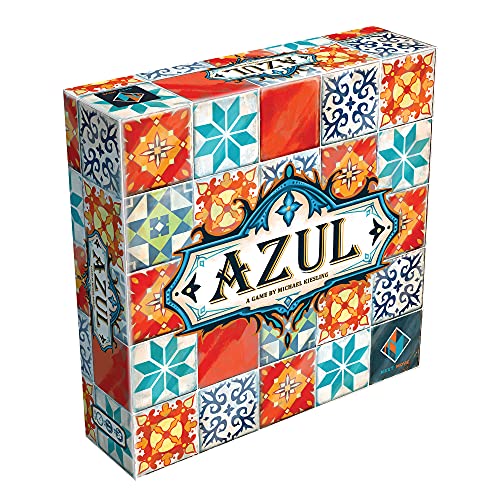
Azul is the quiet, beautiful option. Players draft colorful resin tiles from shared factory displays and place them on their own boards to build a mosaic wall inspired by Portuguese azulejos tilework. Scoring rewards completed rows, columns, and sets of one color, and tiles that do not fit your pattern cost you points, so every draft is a small puzzle.
There is no text to read during play, no direct attacks, and almost no luck after the tiles are drawn, which makes Azul a favorite for families who want a calm game that still feels clever. It is also the strongest two-player game in this guide, playing a focused duel at two and a busier shared puzzle at three or four. A game finishes in about half an hour, and the rules can be taught in a few minutes. It won the Spiel des Jahres, Germany’s best-known game of the year award, in 2018. The trade-off is theme: this is an abstract pattern game, so players who need a story should look at Ticket to Ride or CATAN instead.
Specs
- Publisher: Plan B Games
- Players: 2 to 4
- Maker age: 8 and up
- Playing time: 30 to 45 minutes
- Components: 100 resin tiles, 4 player boards, 9 factory displays, 4 scoring markers, 1 starting player marker, 1 linen bag
- Model number: NMG-600010EN
5. Splendor Board Game
Splendor is a fast engine-building game about gem trading. On your turn you either take gem tokens from the supply or spend them on a development card. Each card you own gives a permanent gem discount, so your buying power grows through the game, and cards also carry prestige points. Attracting a noble tile with the right collection of cards adds a further bonus.
A full game takes about thirty minutes, turns are snappy, and there is very little downtime, which suits families who want a strategy game on a school night. The thinking is real but the rules are short: no board to set up and no player elimination. Splendor plays two to four, and the two-player game is a genuine contest rather than a scaled-down version. Because everyone builds quietly at their own tableau, it is less rowdy than CATAN or Codenames. Note that a separate two-player-only version, Splendor Duel, also exists, so check that the listing is for this base game if you want the two-to-four-player edition.
Specs
- Publisher: Space Cowboys (Asmodee)
- Players: 2 to 4
- Maker age: 10 and up
- Playing time: 30 minutes
- Components: 40 plastic tokens, 90 development cards, 10 noble tiles, rulebook
- Model number: SPL01
How to Choose a Family Board Game
Start with player count, because it eliminates options fastest. If two people will play most often, choose between Azul, Splendor, and Ticket to Ride, and leave CATAN and Codenames for when guests come over. If your table regularly seats five or more, Ticket to Ride covers five, and Codenames covers almost any number in teams.
Next, match the maker age to your youngest regular player, and think about reading. Codenames depends on vocabulary, CATAN and Splendor reward planning ahead, while Azul needs no reading at all once the scoring is explained. Then consider time and temperament. Azul, Splendor, and Ticket to Ride all finish in about an hour or less; CATAN is the long game of the group. Finally, decide how much direct interaction your family enjoys: CATAN is built on trading, Codenames on team discussion, and Azul and Splendor are mostly parallel puzzles.
Who Should Skip These Games
Families whose regular players are mostly under eight should skip this list for now and look at junior editions instead, since every game here is rated for ages 8 and up and Codenames is listed at 14 and up. Two-player households should skip CATAN, because the base game does not support two players. Anyone looking for a cooperative game, where the whole family wins or loses together against the game itself, should also look elsewhere: all five of these are competitive, with one winner. And if your group wants a game that reliably ends in fifteen minutes, a dedicated quick card game would serve you better.
FAQ
Which of these games works best with only two players?
Azul and Splendor are the strongest two-player picks, because both stay tense as a duel, and Ticket to Ride also works well at two. CATAN needs at least three players and Codenames needs at least four, so neither suits a two-player household as a main game.
What is the best first game for a family new to modern board games?
Ticket to Ride is the usual answer. Its turn structure has only three possible actions, the goal is easy to explain, and a first game can be taught as you play. Azul is the alternative if your family prefers quiet pattern building.
How long does a typical game night session last with these picks?
Most sessions land between thirty and ninety minutes depending on the title. Azul and Splendor take about thirty minutes, Ticket to Ride runs thirty to sixty, and CATAN is the longest at sixty to ninety minutes, especially while players are learning the trading rhythm.
Do any of these games need expansions to be enjoyable?
No. All five are complete base games with plenty of replay value in the box, thanks to variable setups, destination tickets, key cards, and tile draws. Expansions exist for some of them, but they are optional additions for later, not required purchases.
Final Verdict
For a single purchase that will please the widest range of families, choose Ticket to Ride (2025 Refresh): it seats two to five, welcomes ages 8 and up, and balances luck, planning, and pace. Add CATAN when your group wants trading and a longer contest, Codenames when the crowd grows, Azul for quiet two-player evenings, and Splendor when you want real strategy in half an hour. The right first buy is simply the one that matches your player count and your youngest player’s age.